
For many families, homework can quickly become one of the most challenging parts of the day. Your child may understand the assignment and have the skills to complete it, yet getting started can feel like an uphill battle.
You may find yourself repeating reminders, negotiating when homework will begin, or sitting beside your child just to help them get through the first few questions.
While homework resistance can be frustrating, difficulty getting started isn't always about motivation or willingness. Understanding what makes homework challenging for your child is an important first step toward helping them succeed.

Why Homework Can Feel Overwhelming
After spending several hours at school following directions, managing social interactions, and completing academic tasks, many children come home mentally and physically exhausted.
For younger children, particularly those transitioning into grades with greater academic expectations, homework also requires skills they are still developing.
These include:
Task initiation: Getting started without repeated reminders.
Executive functioning: Planning, organizing, and determining what needs to be completed.
Emotional regulation: Managing frustration when assignments feel difficult.
Sustained attention: Remaining focused long enough to complete a task.
For children with ADHD or executive functioning difficulties, these demands can feel especially overwhelming.
What looks like procrastination may actually be a child struggling to figure out where to begin.
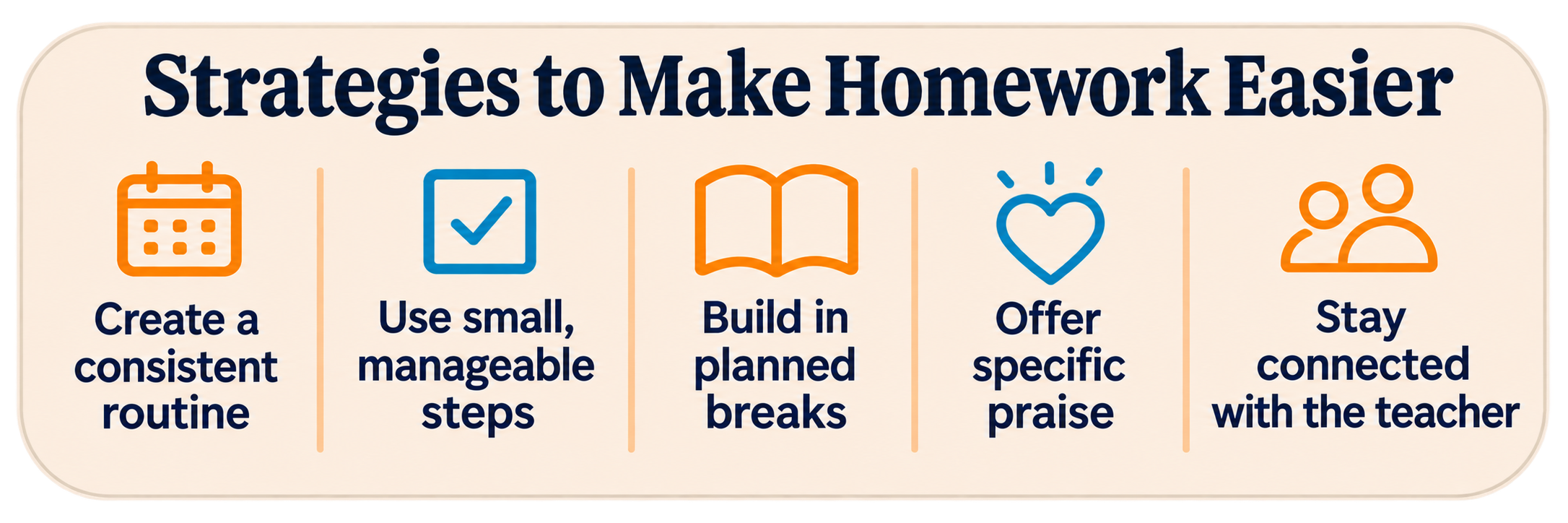
4 Ways to Make Homework Time Easier
1. Create a Predictable Routine
Establishing a consistent homework routine helps children know what to expect and reduces the need for daily negotiations.
Work with your child to identify a realistic time to begin homework, taking into consideration their energy level, after-school activities, and need for downtime.
A predictable routine might look like:
Arrive home → Have a snack → Take a short break → Begin homework.
The goal isn't to create a rigid schedule, but rather to establish consistency.
2. Break Assignments Into Smaller Steps
When children look at an entire worksheet or several assignments, they may become overwhelmed before even beginning.
Instead of saying, "Go finish your homework," try:
"Let's start with the first three questions."
Breaking assignments into manageable steps helps children experience success and builds momentum.
3. Acknowledge and Validate Their Feelings
When your child expresses frustration, resist the urge to immediately convince them that the assignment is easy.
Instead, acknowledge how they feel.
"I know you're tired after a long day at school, and starting homework feels like a lot right now."
Validation doesn't mean removing the expectation to complete homework. It means recognizing your child's experience while continuing to provide support.
You might follow with:
"Let's look at what you have and figure out where to start."
4. Praise Effort Throughout the Process
Children benefit from receiving praise not only when they finish an assignment but also when they demonstrate effort along the way.
Look for opportunities to acknowledge when your child:
Gets started without repeated reminders.
Returns to an assignment after taking a break.
Uses a strategy to stay focused.
Asks for help when needed.
For example:
"I noticed you got started even though you weren't looking forward to homework. That took effort!"
Specific praise helps children recognize the behaviors and strategies that contribute to their success.
Building Independence Takes Time
Children aren't expected to have fully developed executive functioning skills. They learn these skills through practice, modeling, and consistent support.
Some children may initially need an adult nearby to help them begin or stay on task. Over time, that support can gradually decrease as their confidence and independence grow.
Remember, the goal isn't simply to get through tonight's homework. It's to help your child develop skills they can use independently in the future.
Looking for additional support?
If homework frequently leads to frustration, avoidance, or emotional outbursts, your child may benefit from additional support with executive functioning and emotional regulation.
Alexa Wernick, LCSW, ADHD-CCSP, provides child and adolescent therapy and parent coaching in Tampa, Florida, with virtual services throughout Florida and New York.
