
Your child is frustrated because it's time to turn off the television. You calmly explain that screen time is over, but within seconds, they're yelling, crying, or refusing to listen.
You may find yourself repeating directions, explaining why the rule exists, or becoming frustrated yourself.
These moments can be challenging, especially when your child's emotional reaction seems much bigger than the situation.
However, emotional regulation is a skill children develop over time, not something they're automatically expected to know how to do.
How adults respond during these moments can play an important role in helping children develop that skill.
Why Children Experience Big Emotions
Children are still learning how to recognize, understand, and manage their emotions.
When frustration, disappointment, or anxiety becomes overwhelming, they may struggle to communicate their feelings effectively.
Instead, their emotions may appear through behaviors such as:
Crying or yelling.
Refusing to follow directions.
Arguing or talking back.
Withdrawing or shutting down.
Throwing objects or acting impulsively.
Although these behaviors may be difficult to manage, they often signal that a child is having trouble coping with an uncomfortable emotion.
This doesn't mean every behavior should be accepted. It means understanding the emotion and addressing the behavior are two separate parts of responding effectively.
4 Ways to Respond in the Moment
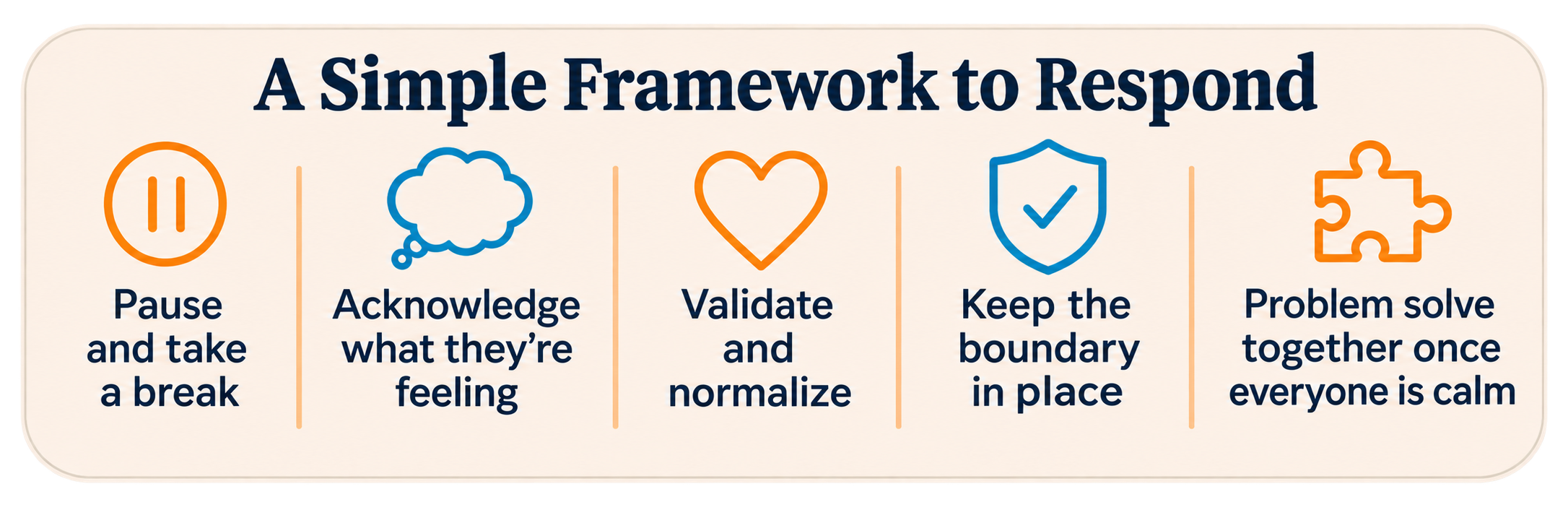
1. Regulate Yourself First

Children often look to adults for cues about how to respond to stressful situations.
When your child becomes upset, take a moment to notice your own emotional response.
Pause, take a breath, and try to maintain a calm tone.
You don't need to feel completely calm to respond effectively. The goal is to avoid allowing your own frustration to escalate the situation.
2. Acknowledge, Validate, and Normalize
Before jumping into problem-solving, acknowledge what your child is experiencing.
For example:
"I can see you're frustrated because you wanted more time to play. It's disappointing when we have to stop doing something we enjoy."
This approach communicates three important messages:
Acknowledge: I recognize how you're feeling.
Validate: Your emotional response makes sense.
Normalize: Everyone experiences uncomfortable emotions.
Validation doesn't mean agreeing with your child's behavior or changing the boundary.
You can recognize their disappointment while maintaining the expectation that screen time is finished.
3. Keep Your Language Simple
When children are emotionally overwhelmed, lengthy explanations and repeated directions are often less effective.
Rather than continuing to explain why something needs to happen, use brief, calm statements.
For example:
"I know you're upset. Screen time is finished. We can talk when you're ready."
If your child needs time to calm down, allow space while maintaining appropriate supervision and safety.
4. Address the Behavior Without Dismissing the Emotion
All emotions are acceptable, but not all behaviors are.
For example:
"It's okay to feel angry. It's not okay to hit."
This distinction teaches children that experiencing an uncomfortable emotion isn't wrong, while reinforcing expectations for safe and respectful behavior.
When your child is calm, you can help them identify a more effective response for next time.
Problem-Solve Once Everyone Is Calm
After your child has regulated, revisit what happened.
Ask questions such as:
"What were you feeling when that happened?"
"What was the hardest part?"
"What could we try differently next time?"
Together, identify a coping strategy your child can practice, such as taking a break, using an "I statement," asking for help, or taking deep breaths.
These conversations are most effective when children are calm enough to reflect and participate.
Remember: Progress Takes Practice
Developing emotional regulation skills takes time, repetition, and support.
There will still be moments when your child becomes overwhelmed, even after practicing coping strategies.
Rather than expecting every difficult moment to disappear, focus on gradual improvements in how your child recognizes, expresses, and manages their emotions.
Your child doesn't need you to eliminate every uncomfortable feeling. They need support learning how to navigate those feelings.
Looking for additional support?
If your child frequently struggles with frustration, emotional outbursts, or managing uncomfortable feelings, child therapy and parent coaching can help build emotional regulation skills.
Alexa Wernick, LCSW, ADHD-CCSP, provides child and adolescent therapy and parent coaching in Tampa, Florida, and virtually throughout Florida and New York.
